
Planting
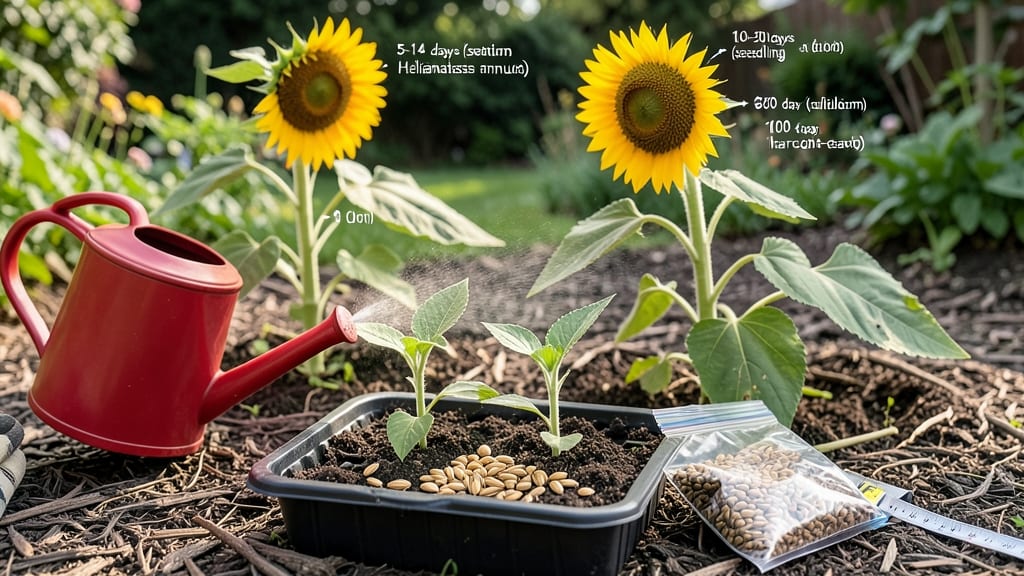
To grow a sunflower from seed to its towering 🌻 glory takes longer than most gardeners expect—and the timeline can vary wildly depending on your approach.
While some varieties might surprise you with blooms in as few as 50 days, others take nearly four months to reach their full height, making patience (and the right conditions) the real game-changer.
What’s even more fascinating is how quickly those first signs of life appear. Within just 5-10 days after planting, you’ll start seeing tiny green shoots pushing through the soil—proof that sunflowers are nature’s speed demons when it comes to germination.
But here’s the catch: rushing the process by overwatering or planting too early can actually slow things down, leaving you waiting longer for that first cheerful face to appear.
Once those seedlings emerge, the real magic begins. In just 2-3 weeks, they’ll shoot up like jack-in-the-boxes, reaching heights that seem impossible for something so young.
But the journey doesn’t stop there—each stage, from leafy greens to that iconic golden bloom, comes with its own set of care tips to keep your sunflowers on track for a fast, healthy finish line.
Whether you’re a first-time gardener or a seasoned pro, understanding these stages—and what influences them—is the key to growing sunflowers that don’t just survive, but thrive. Let’s break down exactly what to expect, week by week, so you can set your sights on those sunny, sky-high rewards.

Sunflower growth stages: exact timeline from seed to full bloom
Sunflowers are nature's fast-track plants, transforming from tiny seeds into towering giants in just a few months—but their journey through four distinct growth stages holds fascinating details. Understanding these phases helps you predict bloom times, troubleshoot delays, and celebrate milestones like first sprouts or bud formation.
Let's break down the exact timeline from seed to full bloom, including what to watch for at each step.
Most sunflower varieties complete their full growth cycle in 80-120 days, though dwarf varieties may bloom in as few as 50 days. The timeline varies based on seed variety, growing conditions, and environmental factors like temperature and sunlight.
Even experienced gardeners are often surprised by how quickly these plants grow once they establish their taproots and leaf canopy.
Visual tracking is key to monitoring progress. Look for cotyledon leaves (the first true leaves) appearing within 7-14 days of germination, followed by rapid stem elongation. The transition from vegetative growth (leaf production) to reproductive growth (flower bud formation) is particularly dramatic and marks the final countdown to bloom.
| Stage | Key Visual Indicators | Average Duration | Critical Care Tasks |
|---|---|---|---|
| Germination | Seed cracks open; white radicle emerges first | 3-14 days (ideal: 5-7 days) | Maintain 70-80°F soil temp; keep moist |
| Seedling | Cotyledons (first leaves) appear; true leaves unfold | 14-21 days | Thin seedlings to 12" apart; provide full sun |
| Vegetative | Rapid stem growth; leaves reach 6-12" tall | 21-42 days | Stake tall varieties; fertilize with 10-10-10 |
| Reproductive | Bud forms; petals begin opening | 28-56 days (varies by variety) | Reduce watering; protect from pests |
| Full Bloom | Petals fully open; center disk turns brown | 1-2 weeks (peak bloom) | Harvest seeds when back turns yellow |
The germination stage is the most critical for timing. Seeds typically sprout within 3-14 days, but this window can stretch to 21 days in cool soils (below 50°F). I've found that pre-soaking seeds overnight in warm water cuts this time by nearly half.
During this phase, maintain consistent moisture—never let the soil dry out completely, but avoid waterlogging, which can cause rot.
Once seedlings emerge, you'll notice cotyledons (the first leaves) within 7-10 days of sprouting. These heart-shaped leaves are followed by true leaves that look more like mature sunflower foliage.
This seedling stage lasts about 2 weeks and is when sunflowers develop their deep taproots, which anchor them for rapid upward growth. Thin seedlings to 12-18 inches apart to prevent competition.
The vegetative stage is where sunflowers show their growth superpowers. In ideal conditions, stems can elongate 3-5 inches per day during this 3-6 week phase. You'll see leaves grow larger and more numerous, and the plant will develop its characteristic rough, hairy stems.
This is also when you should stake tall varieties (like 'Mammoth' or 'Russian Giant') to prevent toppling in wind or rain.
Transitioning to the reproductive stage is one of the most exciting milestones. Look for a bud forming at the stem's top—this signals the plant is shifting energy from leaf production to flower development. The bud will swell and eventually open into the familiar yellow-orange bloom.
This phase typically takes 4-8 weeks, depending on the variety and growing conditions. Dwarf sunflowers may bloom faster, while giant varieties take longer.
Full bloom arrives when the petals fully open and the center disk
Factors that speed up or delay sunflower germination and growth
Sunflower seeds are resilient, but their growth speed depends heavily on environmental conditions. The soil temperature is the single most critical factor—seeds need 50-60°F soil to germinate. Cold soil slows everything down, while warm soil (above 80°F) can speed up sprouting but may cause seedlings to bolt too quickly.
I’ve learned this the hard way after planting too early in cool spring soil!
Moisture levels also play a pivotal role. Sunflower seeds require consistent moisture but hate soggy soil. Overwatering can lead to rot, while underwatering causes seeds to dry out before germinating.
Aim for 1 inch of water per week, delivered through deep watering sessions rather than frequent light sprinkles. My morning watering routine ensures excess moisture evaporates by evening.
Sunlight exposure directly impacts growth speed after germination. Sunflowers thrive in full sun (6-8 hours daily), but seedlings need partial shade if planted in intense afternoon heat. Too little light results in leggy, weak stems, while too much can stress young plants.
I always start seeds indoors under grow lights before transplanting to avoid shock.
Sunflower Germination & Growth Factors
✅ SPEEDS UP GROWTH
- Warm soil (50-80°F): Ideal for germination
- Consistent moisture: Keeps seeds hydrated
- Full sun (6+ hours): Boosts photosynthesis
- Fresh seeds: Higher viability than old seeds
- Loose, well-draining soil: Prevents compaction
❌ DELAYS GROWTH
- Cold soil (<50°F): Slows germination
- Inconsistent watering: Causes stress
- Partial shade: Weakens seedlings
- Old/damaged seeds: Lower viability
- Compacted soil: Restricts root growth
Optimal conditions reduce germination time from 7-14 days to just 3-7 days!
Seed quality makes a surprising difference. Fresh seeds from reputable suppliers germinate 90%+ of the time, while older seeds (over 2 years) may struggle. I always check seed packets for germination rates and test a few in damp paper towels before full planting.
This simple step saves hours of waiting for seeds that might never sprout!
Soil composition affects root development. Sunflowers prefer well-draining, slightly acidic soil (pH 6.0-7.0). Heavy clay or sandy soil can stunt growth. Amending with compost improves nutrient availability and water retention. My go-to mix is 50% garden soil, 30% compost, and 20% perlite for perfect drainage and fertility.
Finally, avoid common mistakes like planting too deep (1 inch max) or crowding seedlings. Spacing matters—give mature sunflowers 18-24 inches apart to prevent competition. I’ve seen gardens where overcrowding led to pale, stunted blooms—a heartbreaking sight after all that waiting!
Proper spacing ensures each plant gets the nutrients and sunlight it needs to reach its full potential.