
Flowers
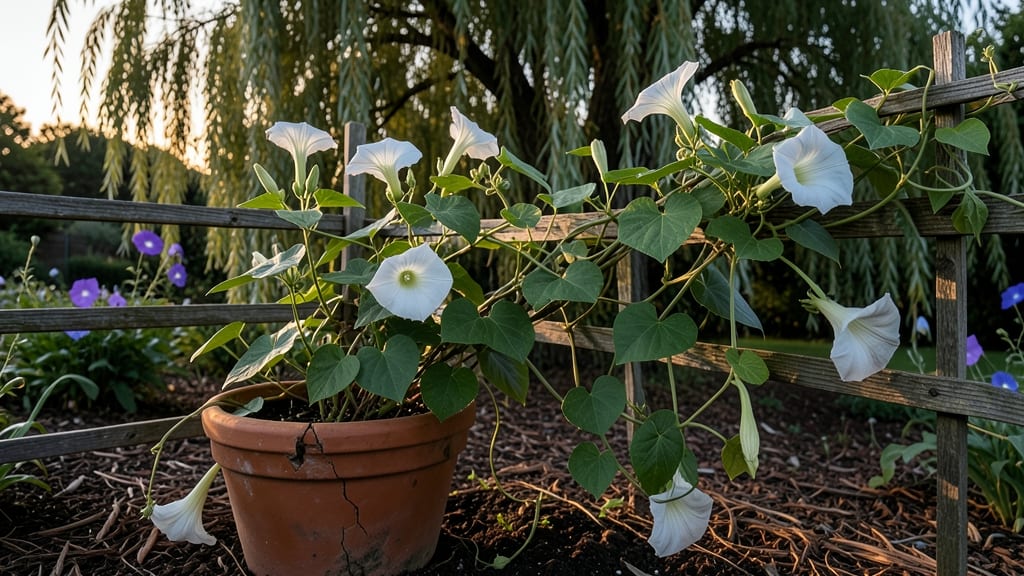
If you’ve ever wondered how tall Moonflowers grow and dreamed of a garden that glows under the moonlight, these night-blooming beauties are your answer—but their towering vines can turn your space into a jungle if you don’t plan ahead.
These stunning climbers can reach heights of 10–25 feet, depending on the variety and growing conditions, making them a dramatic (but space-hungry) addition to any landscape.
Most gardeners plant Moonflowers without realizing how quickly they’ll climb, only to find their trellises or fences overwhelmed by sprawling vines.
The key to success lies in understanding your specific variety—whether it’s the classic Ipomoea alba or a shorter bush-type—and how to guide its growth before it gets out of control.
In this guide, I’ll break down exactly how tall Moonflowers grow, how fast they climb, and the simple tricks to keep them in check—from trellis placement to pruning tips.
Whether you’re designing a romantic nighttime garden or just want to avoid a vine takeover, you’ll learn how to harness their dramatic height for your space.
Ready to turn those dreamy night-blooming displays into a reality? Let’s dive into the heights, habits, and hacks that make Moonflowers both magical and manageable.


Moonflower height by variety: vining heights explained
Moonflowers (Ipomoea alba) are fast-growing vines that can reach impressive heights, but their growth varies dramatically by variety and climate conditions. Without proper support, these night-blooming beauties can sprawl uncontrollably, smothering nearby plants or climbing over fences.
Understanding their mature heights helps you plan trellises, arbors, or even ground covers strategically.
The most common variety, Ipomoea alba (common moonflower), typically matures between 10–25 feet in a single growing season, depending on warmth and moisture. Meanwhile, the Japanese moonflower (Ipomoea nil) often stays shorter at 6–12 feet, making it ideal for smaller gardens or containers.
These differences matter when choosing varieties for your space.
Gardeners in USDA Zones 9–11 often report 20+ foot vines by late summer, while those in Zones 6–8 see more modest 10–15 feet due to shorter growing seasons.
Even within the same zone, support structures like trellises or pergolas can influence height—unsupported vines sprawl wider but may climb higher when given vertical guides.
In my own Zone 7a garden, I’ve seen Ipomoea alba vines climb a 12-foot arbor in just 8 weeks with consistent watering and morning sun. However, last summer’s drought slowed growth to only 2 feet per month, proving how water availability impacts height.
If you’re in a drier climate, prioritize mulching and deep watering to encourage vertical growth.
For small-space gardens, dwarf varieties like 'Moonlight' stay under 6 feet and thrive in containers, making them perfect for patios or balconies. These compact types also bloom earlier, giving you nighttime fragrance without the sprawl.
If you love the look but lack vertical space, consider training vines along a horizontal trellis instead of a tall one.
One common mistake I’ve seen is assuming all moonflowers need full sun to reach max height. While they do need 6–8 hours of sunlight, partial shade can reduce vine length by 30–50%.
In my shadier backyard, moonflowers grew only 8 feet tall compared to 18 feet in the sunniest part of the yard. This trade-off is worth noting if you’re balancing bloom size with vine control.
When planning your garden layout, account for not just height but also spread. A 20-foot vine can cover 10–15 feet horizontally if unsupported, smothering nearby plants. I’ve seen gardeners use wire cages or obelisks to contain vines, creating a vertical focal point without sacrificing space.
For example, a 6-foot obelisk can support a 10-foot vine while keeping it off the ground.
If you’re growing moonflowers near companion plants, choose fast-growing ground covers like liriope or creeping thyme to fill gaps beneath sprawling vines. These plants thrive in the dappled shade created by moonflower canopies while suppressing weeds.
In my perennial border, I pair moonflowers with black-eyed Susans—the Susans bloom in daylight while the moonflowers take over at night.
Finally, remember that first-year growth is often slower than subsequent years. Seedlings may only reach 3–5 feet in their first season but can double in height the following year. This means planning for long-term support from the start, even if your vines seem small early on.
With the right variety and care, your moonflowers will become the dramatic centerpiece of your garden’s evening show. 🌙
How to control moonflower growth: pruning, trellising & space planning
Moonflowers (Ipomoea alba) can reach 10–25 feet when left unchecked, but with the right techniques, you can guide their growth to fit your space perfectly.
The key lies in pruning at the right time, choosing the right support structures, and planning your garden layout to accommodate their rapid ascent. Without control, these vines can become unruly, smothering nearby plants or sprawling across patios.
Start by understanding that moonflowers grow fastest in warm climates and with abundant sunlight. In my Zone 7b garden, they climb 3–5 feet per month during peak summer. If you notice vines growing too aggressively, it’s time to intervene—either by pruning or redirecting their growth upward.
The goal is to maintain a balanced, healthy vine that produces abundant blooms without overwhelming your space.
🌿 How Tall Do Moonflowers Grow?
- 🌱 First Year: 5–8 ft (with support)
- 🌿 Mature Height: 10–25 ft (varies by variety)
- 🌳 Without Support: Spreads 6–10 ft wide (ground cover)
- ✂️ Pruned Height: 6–12 ft (trainable with trellises)
To control their height, I recommend pruning in early spring before new growth begins. Cut back overgrown vines by 1/3 to encourage bushier growth and more flowers. Avoid heavy pruning in late summer, as this can reduce blooming time.
For vertical growth, install a trellis, arbor, or pergola early in the season—moonflowers twine naturally and will climb eagerly if given a sturdy structure.
Common mistakes include waiting too long to prune or using weak supports like flimsy fences. I once let a moonflower vine wrap around a chain-link fence, and by mid-summer, the fence was sagging under the weight. Instead, opt for wooden arbors or metal trellises that can handle the weight.
If you’re short on space, consider container gardening with a tall cage or obelisk—just ensure it’s at least 6 feet tall to accommodate their growth.
For sprawling gardens, let them grow naturally but train vines along the ground using stakes or low trellises. This creates a lush ground cover while still allowing vertical growth where desired. Mulch around the base to prevent weeds and retain moisture, which encourages healthier vines.
If you notice weak stems, it’s often a sign of overcrowding or poor sunlight—thin out nearby plants to give your moonflowers room to thrive.
With the right balance of pruning, support, and space planning, you can enjoy moonflowers that climb gracefully without taking over your garden. The key is to intervene early and provide the right structures—then sit back and enjoy their stunning nighttime blooms without the chaos. 🌙